Saturday, May 3, 2014

UX in the garden

Who experiences the garden? We do, our close neighbors do, and so do the people who come past the house walking their dogs or with kids in strollers.

Maybe a better question is to ask what "experiences" the garden because there is a huge presence life on the ground and just below the surface. 


When I first started to design this garden I had little idea of where it would go. Vaguely aware of changing light over the course of a day, I had barely an inkling that the light could change over the course of a year, or that trees growing nearby would decrease the light over time, or even that the things I planted myself would change the light, heat, and water distribution in the garden. 

Over the years squirrels and other animals have distributed things, randomly or not, in a way I couldn't have predicted. And spreading plants, airborne seeds, and new additions have changed the garden's composition. 


As things change at the surface they have also changed in the soil. So new fungi, new microbes, and new invertebrates have become established. The garden plot is the same as when I started. It's the same dimension in terms of square feet. But the dimensions above and below have changed. And so has the operating system. 

So what's the connection with "user experience?" A lot I think. Part of it is that you can't plan every detail. But you can create a matrix, like a welcoming garden, where "users" (in this case all the organisms) can come to play. The matrix will change over time and come to re-form itself, partly as a random process and at some level, as part of the design. For sure your control as a designer is minimal and maybe that's the best way. An environment where things run themselves may be the most sustainable.


Sunday, April 27, 2014

Keeping the soil in shape

Our urban garden is small and narrow. I wanted to introduce some height to the surface so it wouldn't be just a flat boring garden. But how to preserve the new lay of the land and still get into the garden to do some work?

For part of my path into the garden I built a narrow walkway with old spare bricks that were lying around. Over the years it became overgrown, first with the mosses I wanted and then with more rank growth. I went to work re-exposing it this year and happily discovered that the soil around it was raised two or three inches...just enough for a piece of micro scenery and a place for the cat to saunter. 


How about further into the garden, where I want to maintain a little more surface height? Last fall as I harvested the Jerusalem artichokes I laid their long stems in a parallel arrangement so they formed a kind of loose "sidewalk." 


This worked pretty well. When I sneak back into this part of the garden they distribute my weight and preserve the lift and texture of the soil underneath, adding material as they disintegrate. Minimal compaction is what I'm after, along with a medium that will allow plenty of opportunity for things to pop up once I'm through pruning my lovely ninebark and in June, the fragrant but out of hand mock orange. 


There's one negative to my technique. The moldering stems make great habitat for snails. I haven't found any way to control them anyway, other than picking them off one by one, so I guess the trade off is worth it. 

Saturday, April 26, 2014

Eradicating garden weeds: Not

A few weeks ago in the California desert we were treated to a wonderful show of native flowers. It looked like the flowers were emerging from "nothing." How could these beauties pop up out of mud, rocks, and sand? I realized the desert soil must be full of seeds and dormant plants,  waiting for the right conditions to spring into action. "Seed banks" are an invisible part of the landscape but they're very much there. 

When we moved to our place in Cambridge, Massacusetts about 15 years ago what's now our garden was a long dusty dog run. The few plants that existed were the hardiest weeds, capable of surviving the exposure and stresses of dogs doing all their doggie things year after year. And during those years, while the dogs deposited their contributions the weeds deposited many generations of seeds into the dry and dusty soil. 

When we started our garden it was the ripe repository of lots of unpleasantness, including a tough population of weeds. 

Now there's nothing wrong with weeds. Most of our lovely garden plants, as well as our important crop plants, came from weedy ancestors. These are the kinds of plants that survive in disturbed soils that are exposed to wind, sun, and rain. The most serene garden is a tough neighborhood, full of species that want to dominate one another and take what limited resources are available. 

It's no surprise that our garden spaces harbor unwanted plants that we call "weeds." Especially a place like ours, which started out weedy, is bound to bring up lots of unintended shady characters. And the weeds can travel. Not just seeds, but roots and stems, above and below ground, work their way through the garden and show up where they're least expected. What can we do about these unwelcome party crashers? Well think about it. They were here first. Before we slather them in pesticide let's learn a little bit about how and why they grow here. We can't make them disappear. But if we have the time and inclination we can curate them out of the garden and into the compost pile. 


Saturday, October 26, 2013

Time-sensitive ecology of the hairy fungus

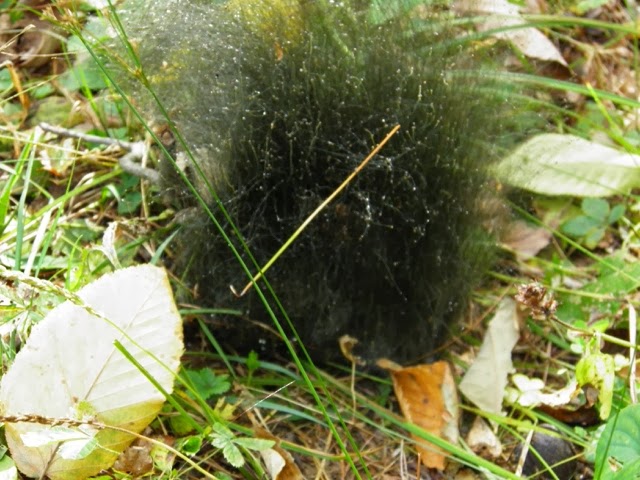
My friend and colleague Peter Busher was out doing fieldwork near his study site at the Quabbin Reservoir in Massachusetts. He took pictures of this creepy fungus that looked like a giant hairball. It was growing on fresh bear dung. 


Phycomyces is a fungus related to bread mold. Like many of the fungi in the bread mold group (Zygomycetes) it has evolved to grow on substrates that are high in sugar (Peter had seen the steaming pile, full of berries, on the road just a couple of hours before). This fungus is one of the first to colonize the fresh feces of vertebrates. 

Not a lovely proposition but perhaps not as gross as it sounds. Something out there has to get the process of decomposition started. And when the hairy fungus has exhausted the nutrients available to it something else takes over. Sooner or later the pile of shit is consumed and the road is clear again. 


The landscape we observe, human and otherwise, is a time-sensitive space. Things happen in it on time scales that range from nanoseconds to eons. Our time is like a snapshot. There are great volumes of existence in time before and after us. 

What does this have to do with Phycomyces? This ancient fungus, which has been around as long as land mammals (hundreds of millions of years), lives its life cycle in a matter of hours. Other components of the landscape, like the pond where Peter studies beavers, are a longer-lasting feature, though the ponds too are part of a cycle. Hundreds or thousands of years later they are gone, a tiny sliver of time. The flutter of a leaf is part of the landscape too. Something that ephemeral seems too short lived to be of any significance. But is it less important than the Phycomyces? The leaf falls, the hairy fungus disappears. The pond is overgrown and dries up. But at its muddy bottom, perhaps hundreds of feet down, lies pollen that was released in a moment during a day in spring, millions of years before. 


Friday, October 4, 2013

Something useful from something arcane

I focused on lichen morphology and morphogenesis for my PhD work at Harvard and subsequent research. My goal was to identify form and the development of form in lichens. Most authors treating my taxonomic group, the Cladoniaceae, had thrown up their hands trying to make sense of form in these lichens. Lichen chemistry, a more "scientific" approach than microscopy, was the accepted modality for identifying and classifying Cladonia lichens. 


My work kept me busy and it was a lot of fun. I delved into mysteries of lichen form that no one had examined before. And I made some real progress in terms of identifying commonalities among species in my group, based on their inherited developmental process. For me, process was always more important than the "finished product" because mature lichens (just like mature trees only smaller) are affected by the environment. A branch may fall off, a branch may grow bigger, shapes change as things happen in the surroundings.


This was science for its own sake, research without a practical application. At least not one that I could see at the time. Not a sterile pursuit by any means, but an end in itself without "value" outside of its own framework.

I put away that research with some sadness, not knowing the direction I would go in. Since I finished at Harvard teaching has always been my focus and it kind of took over. Not a bad thing. There's a huge amount to learn from the process of teaching. 

This year I made some breakthroughs in my teaching approach. If you've been following my recent posts in my other blog, "Scientist/Artist," you have some idea of what has conspired. 

http://scientistartist.blogspot.com/

Another breakthrough came along this week as I shared one of my research papers with students. The goal was not to have them understand lichens or lichen morphogenesis, but to have the opportunity to look at some scanning electron micrographs, something new for them. More important, I wanted my students to grapple with issues of form and form making. I reason that engaging with difficult problems like this, students will prepare themselves as critical thinkers, something that will serve them far beyond my classroom. These are some of the pictures they looked at:


So I had students read the article, focusing on the figures rather than the dense scientific text. Their attention, their focus, and their responses showed me that they were encountering something new and interesting. 

Since nature is full of abstract signals, I figured my lichen SEMs would provide material at once adequately abstract and challenging. Once you've looked at the way a lichen tip forms branches you're ready for just about anything. 

For me, using this old, arcane research and fueling excitement in non-science major undergraduates was a kind of completion of a circle. Instead of a dead end, my research photos provided food for thought. Instead of a too-narrow pursuit, my ideas were put to work challenging and expanding young minds. New ways of looking at science and new ways of encountering nature. New ways of thinking. Very rewarding developments.

All photos shown here were drawn from: Hammer, S. 2000. Meristem growth dynamics and branching patterns in the Cladoniaceae. American Journal of Botany 87: 34-47. 

Wednesday, September 18, 2013

Cold soil: a signal from below

Thinking about plant senescence as we turn the corner into fall. I realize it's not just sunlight that affects growth processes in plants. It's also soil temperature. 

Getting ready for the big move in in October, I've started emptying the pots with hot weather plants like coleus. The plants lost most of their color and a lot of their leaves over the past few weeks and the purple spikes of flowers have long gone to seed. As I turn the pots over I realize the soil is cold, even in the afternoon. 

Well it makes sense. Cold nights in the 40s and daytime highs that just reach 60 make for cold soil. A message to the plant roots that encourages slowing down. Some of the soil goes on top of the compost heap in back, now a mass of vegetable peelings, corn husks, and old corn cobs. That soil will introduce microorganisms to break down the remains, almost as if the black soil self regenerated. 

Some of the soil, the cleanest, will go into the soil container, to be re-mixed and used next spring for the new potted annuals. 

And some of the soil, the stuff I can't easily separate from tightly packed roots or stubborn stems, I'll throw back into the garden, whose surface seems to sink an inch or two every year. 

Cold soil in the pots reminds us that we're entering a time where everything, not just the house and not just the air, is readjusting for a new season. 

Monday, September 16, 2013

Questions about lichens: Form? Function? Biology?

Some years ago, I had the opportunity to take several series of electron micrographs of lichens. I was focusing on a project on the Cladonia lichens of Australasia and thanks to the National Science Foundation and the National Geographic Society I had the chance to explore far and wide, documenting my collections at the Australian National University in Canberra. 

It was an ambitious project. You might even call it audacious. Because work like this hadn't been undertaken with lichens before. The more time I spent with my colleague at ANU, Roger Heady, who was in charge of the electron microscope laboratory, the more we started to detect interesting patterns and processes in the lichen samples I brought to be photographed. Roger was an intrepid worker and he encouraged me to look close, to look closer, and to look a lot. We spent hours getting lost in growth patterns of lichens that were evident at a very small scale, about 100 microns (1/10 of a millimeter).

I published lots of data from that exploratory time, but by no means all of it. The academic lichen community, small and conservative, found it hard to swallow what was obvious to me: lichens attain their shape in a programmed, controlled, and predictable manner. 

Lots of other questions arose as well. I call them "biological questions" because they go beyond the questions of pure form and form-making in lichens. Pursuing lichens in the field I became ever more curious about their ecology. Lichens are part fungus and part photosynthetic organism (algae or photosynthetic bacteria). But very often I would find evidence of the lichen fungus (without its photosynthetic partner) in wood or on leaves. 

The first photo below shows a diffuse lichen body growing on a moss. Is the lichen growing in a purely epiphytic manner (using the moss as a kind of "platform") or have its fungal hyphae invaded the moss body?


The second picture shows part of a lichen colony growing on a rainforest leaf. Since many plants in the rainforest retain their leaves over a number of years, lichens, which are relatively slow growing, can establish there. Again, is this lichen growing epiphytically or have some of its hyphae (elongated cells) penetrated the leaf? The visual evidence for penetration is not particularly strong. But the situation is possible.


I asked these questions because I took several pictures of fungal hyphae, unmistakably belonging to the lichen, in rotting wood and in deposits of leaf litter, shown in the bottom photo. In this photo we see the hyphae ramifying throughout the cellulose-rich substrate. I haven't done experiments to show whether the fungal cells are also digesting the leaf litter, but their abundant presence is demonstrated in these pictures.


As a parting thought I encourage scientists and non-scientists as well to think beyond the boundaries of their discipline. Looking at the lichen "model" as a fungus and its photosynthetic partner, and not allowing any doubt to sneak in, is a too-narrow interpretation. Maybe we don't have the evidence yet, but maybe there are other nutritional modalities that lichens experience, maybe for specialized times during their life cycle. 


Sunday, September 8, 2013

Grapes!

I was sitting out in back yesterday when I started sneezing like anything. I don't get allergic easily and I don't have a cold, so I started looking for the culprit.

All around the house and garden this year we have been in a kind of grape heaven. The seedless champagne grapes I planted a few years ago have really come into their own. And Janet's concord vine took over the back and side of our house. Neighbors (not very perceptive ones) even pushed our vine down when it started to beautify their fence. 

Well the cause of all the sneezing was the grapes. Either that or the bugs, spiders, and birds hanging around in them. So I decided to cut. Five huge bowls later I was the dubious owner of a ton of redolent grapes. Nothing to do but clean them. 

That was a good choice of activity. Sometimes a little repetitive cleaning gives the brain a break. The fingers enjoyed handling the endless eyeballs and a sense of accomplishment set in. 

Once they were clean, I poured my grapes into a large pot and cooked them down, letting them cool overnight. This morning came the straining. Skins and seeds went into the compost and what was left? A big pot of foamy thick grape juice. The rest of the day I spent boiling it down. Until just a few minutes ago when the bottom of the pot was just the consistency of oatmeal when you take it off the flame. 

A little sour, very rich, with any luck Janet will enjoy the condensed fruit on top of her rice cakes for a few weeks. 


Friday, September 6, 2013

Potatoes and the praying mantis

Well the potato plants, which had grown massive and fulminant in June and July, look pretty sparse by now. Last night it dipped down into the cool 50s, so I figured I would start the tearing-down process, an arc of activity that ends in mid-late October, about six weeks from now.

The soil surprised me by how cool it was and even more surprising was my puny crop of potatoes. Lots of good soil, lots of great green growth, not a lotta potatoes. 

Well I'm always writing about how diverse my garden is so I guess I'll shrug off the understated potato performance and brag about our praying mantis. It was tiny when we first saw it in the garden a couple of months ago. Now all grown up and strange looking, the mantis is a success story. 

With so many plants and such diverse spaces, we host a real plethora of insects. The abundance and diversity of the insect community here on Cottage Street is underscored by the praying mantis. A consummate predator of insects, the voracious mantis proves again that there are plenty of good snacks that grow in this garden. It's just that not all of them are for us. So what if our potatoes didn't turn out so wonderfully? There are lots of Jerusalem artichokes, still not yet in bloom, growing under the soil. 


Friday, August 30, 2013

Hauntingly beautiful parasite

As you wander through the murky Maine forest, its damp air heavy with the scent of pine, you stumble across a ghostly cipher, pushing its way up through the soft ground. Indian pipe is utterly without chlorophyll, unable to perform photosynthesis. What fluke of circumstance and shared need brought about this unusual relationship? How did it evolve to be totally dependent on its host plants? How did it find the fungal partner that connects it to its source of nutrients? Why up here in Maine? 


Thursday, August 22, 2013

Irresistible Dahlias

Got lost yesterday in the Jardin des Plantes in Paris. I ran into these irresistible Dahlias. 


Saturday, August 17, 2013

Our incredible world

I walk out into the morning garden. Hushed, shadowy, still. The many details in breaking light are monuments of softness. Realities made of paper fiber, stretched to impossibly gracious shapes. 

One form stands out, brimming with life and life's activity. This form tells us everything about the plant world. Everything about the world we live in. 


Friday, August 16, 2013

Garden action

The Jerusalem artichokes are putting on their last couple of unbelievable inches before they burst into flower. The gigantic eupatorium is a huge collection of blossoms and bees, who orbit like electrons around a giant molecule. The pumpkin vine pushes out a new leaf each day while the leaves near its base are covered in powdery mildew. It seems like just yesterday it was summer. But the warmth is fragile and easily broken, unless we sink slowly into pillowy nights of balmy breezes. 

Every plant has its pollinator, often more than one. I catch two bees sleeping in a sunflower. A third comes in and rouses them temporarily, then it falls asleep too. 

There are predators for every insect, more spiders than I've ever seen, wasps of every stripe, and a surprise return to our garden, a praying mantis. Sighted again this year, just like last year, by Julia. 

Morning glories spread in the dewy morning while the potato plants grow a bit too tall, just that extra ray of sunshine is what they lack. The brave bee balm, better than ever now that it's established and trying to become weedy, puts out an extra whorl of flowers. A late season treat.  

The lizard-like heads of black cohosh aim for the sun like periscopes, while weeds that hid all year, like the epilobium growing in someone else's pot, make a brash appearance. Quiet comes with the muted light, I let the dry spaces be, the cat takes a sip from the fishpond, and the plants wait. 


Saturday, July 20, 2013

Keeping cool while it's hot

During these hot days of July I've been keeping a close eye on the garden. Heavy rains early this summer encouraged generous growth, and I've been a bit worried as I watch the ferns fainting, the production of flowers slowing, and the drooping leaves of the potato plants. Their "performance" isn't what it's supposed to be. 

But the plants have an idea I think. As they sense the shortage of water in their environment plants have a bunch of options they can use to adapt. In the long run this helps them survive the rigors of drought and heat. 

One strategy they use is to close their stomata. Stomata are the pores, mostly on leaves but also present on other parts of the plant, that take in carbon dioxide and release oxygen. Plants manufacture their own nutrients from carbon dioxide, which is the raw ingredient for sugars and starch. But while the stomata are open water vapor, a by-product of photosynthesis (like oxygen), is also released. Plants lose water, lots of it, whenever they do photosynthesis. So in these hot, dry weeks our garden plants slow down. You could say they're on a kind of fast, just depriving themselves of nutrients for a few hot hours of the day to avoid overdoing it. 

The by-product of the "fast" is something we can observe. Fewer and smaller flowers, less than perky plants. Well it's July, and most of the plants have laid in a good store of resources already. So a few days of slowing down won't hurt them, not as much as a super soaking will hurt my water bill. 

I've been watching our cat too. Fin is a Maine coon, hairy and luxuriant. He's happiest in a blizzard or under the misty dripping April sky. Poor guy.  All he's been able to do over the past few days is splay himself out on the floor, wherever it's just slightly cooler than the rest of the house. 

Maybe we can take a lesson from nature in this heat. Slow down and chill out. Don't try to "accomplish" so much for a few days. 


Friday, July 12, 2013

Deadheading

Out in the morning garden, a still, cool, fragrant space. The new crop of blossoms pumping out their visual and olfactory luxury. What about the spent flowers? We deadhead them as a habit, partly to remove the unsightly, partly to encourage more buds and future growth.

In the context of garden ecology I look at it a little differently. We recycle our soil from year to year. We just finished loading the last of our reserves into the flourishing containers of potatoes, which threaten now to take over the whole yard. The soil we empty from the pots into our winter bin comes right from the stuff we used all summer. It's a cycle. But not a closed cycle. We are taking something from that soil every year. The leaves and flowers and roots all derive nutrients from the soil. Especially those flowers. Every gardener knows that to get great flowers you need micronutrients. 

So what does this have to do with deadheading? Those spent flowers are reservoirs of nutrient molecules. The life of the flower is short, no time to translocate nutrients back to the plant. If we throw away the dead flowers we're throwing away nutrients that we have to replace by going to the garden store, buying fertilizer, lugging it home, and putting it in the soil. I prefer to recycle the deadheads into the soil, let the microbes break down the plant material, and come out next summer with a new crop of healthy potting matrix. 

Saturday, July 6, 2013

Genius of Aroma

I'm a person who's visually biased- maybe most of us are. Our garden is truly a visual delight. But the visible is every day. Once in a while a garden aroma hits you that brings to mind words like "heavenly," "sublime," or "intoxicating." After a long winter indoors, nursed along by Janet at the foot of her potted Meyer lemon, the Nicotiana has come into full bloom. The lush, rich, ephemeral, transcendent fragrance of this mysterious flower is indescribable.


Thursday, July 4, 2013

Popping Peas

They appear silently, stealthily, in the predawn morning. The day before they were flowers. Tomorrow they'll be too tough to eat. 

Back in April I planted peas, massively, in one of the big plastic pots we keep right outside the house. A spot with morning sun and extended shade after noon. Things were less than promising then, when the soil was cold and wet and the nighttime temps dipped just north of freezing. 

I watched the first greens jealously as they poked through a week or two later. Vulnerable and sweet, too many years these are a snack for sparrow and squirrel. This year they survived the early weeks and climbed with some force up up up. Early June and they started to flower, enjoying what felt like an endless succession of cold rainy days. 

This week as we hit a series of 90-degree days I think it will be time to say goodbye to the peas, still squeaking out the small ones, but reluctantly. The big healthy plants seem to say, "it's not our fault! We can't produce in this weather." But I don't place blame anywhere when it comes to the garden. 

These weeks they have been performing a miracle, converting sunlight into alternate forms of energy and birthing those new tender pea pods, night after night, silently, passively, without complaint. 


Tuesday, July 2, 2013

Complexity, Diversity, Health

We had just moved into our new place, a stretch and a stress with three young kids. I was too poor or too cheap to buy a "real" tree so I rescued a six-inch birch sapling from a piece of soil next to the old basketball court at Hoyt Field. Into the ground it went, out front, next to the street. Not a hopeful spot. Shaded and sucked dry by a Norway maple and right where the neighborhood dogs liked to mark their territory. The soil was sandy and the rest of the "garden" was being used as a dog run by the women who lived next door. 

It got worse before it got better. As the sapling grew to two feet, three feet, the shade intensified, as did the imperious reddish roots of the maple. Then a bad winter, nowhere to put the salty slushy heavy snow than in our front yard. It never had "flowers" or a "lawn" so it took some time before the neighbors understood it was a garden. Meanwhile, anything to get those cars back on the road! So our birch bent and then snapped under the weight of filthy icy crud from the street. It took a few more years until it found its apical meristem and started to grow upward with any enthusiasm. 

Last year I noticed a change, a kind of push upward that accelerated this spring. Just a good season? And about a week ago we saw the first mushroom pushing its way through the thick leaf litter. A decomposer? Maybe...there's a lot down there. And then this morning after days of rain and muggy humidity, an unmistakeable fairy ring. Mission accomplished. The birch had found a mycorrhizal partner in the soil. The fruiting bodies of the fungus had arranged themselves around the growing tips of the roots, exchanging trace nutrients, water, and protection for photosynthetic sugars produced by the tree. From a trashed afterthought to a garden, complex, diverse, healthy. 


Tuesday, June 25, 2013

The Sad Strange Waste of AC

Here in Boston we experience a handful of days each year with high heat and humidity. Yesterday was one of them. I guess you could call it uncomfortable. But really, most of the year here is bone cold. As if by reflex the air conditioners have roared into action.

It's a strange thing in the morning to walk outside and hear the steady crash of the AC, window units, central units, each with a distinctive unpleasant growl. Each gobbling electricity, wasting resources in the dewy cool morning. Meanwhile the garden sends up its moist aroma after last night's thunderstorms, shoulder high plants cooling the air passively through photosynthesis.

At night when it cools down we like to keep our windows open. Everyone could. No one does. Our reward for letting in a breeze is the mechanical thunder of air conditioners, the stupidest solution to making a comfortable house/neighborhood/city.

I know I sound like a throwback. People will complain that AC is a lifesaver, allowing them to sleep, preventing allergies, enabling work and play. But really, in this cold city where we live by the weather, would it hurt to turn off the motors and relish the tropical warmth?


Thursday, June 20, 2013

A collaborative effort

The plant body is a complex system of cells and tissues. It appears to be structurally simple but it is functionally complex. There are so many activities the plant body has to accommodate. Think about it: Circulation of water and nutrients, collection of solar energy, reproductive activities, growth and the production of useful molecules. These are but a few of the multiple functions of the plant body. How can we teach this complicated stuff to undergraduates?

All plant activities require the coordinated effort of many components. How is this coordination accomplished? What controls these activities? How are activities initiated and how are they truncated? What is plant "process?" What is learning "process?"

As I plan my classes for next fall I am excited by the prospect of new innovative lab activities. I just received a grant from the Boston University provost's office, part of the Boston University Arts Initiative. The grant will allow me to buy fun, new and interesting supplies for my students to use. More important, the grant has provided me with encouragement to move ahead combining arts and science in the undergraduate learning environment.

I was just looking at some cool construction toys that I want to introduce. Partly they will be for used when we build enzymes as part of our discussion of protein structure and function. Partly we will use the toys in our broad exploration of form. But perhaps the most interesting opportunity will be to have the students collaborate in building things together. Proteins are built by the collaboration of innumerable processes. On a larger scale plant form is the result of tremendous collaborative activity. Ecosystem evolution is an extremely complex collaborative process. So is learning. Maybe the best way to get this across to students is to have them build things together. In the learning environment, hands on collaboration should prove to be a super interesting interdisciplinary experience.