Sunday, April 27, 2014

Keeping the soil in shape

Our urban garden is small and narrow. I wanted to introduce some height to the surface so it wouldn't be just a flat boring garden. But how to preserve the new lay of the land and still get into the garden to do some work?

For part of my path into the garden I built a narrow walkway with old spare bricks that were lying around. Over the years it became overgrown, first with the mosses I wanted and then with more rank growth. I went to work re-exposing it this year and happily discovered that the soil around it was raised two or three inches...just enough for a piece of micro scenery and a place for the cat to saunter. 


How about further into the garden, where I want to maintain a little more surface height? Last fall as I harvested the Jerusalem artichokes I laid their long stems in a parallel arrangement so they formed a kind of loose "sidewalk." 


This worked pretty well. When I sneak back into this part of the garden they distribute my weight and preserve the lift and texture of the soil underneath, adding material as they disintegrate. Minimal compaction is what I'm after, along with a medium that will allow plenty of opportunity for things to pop up once I'm through pruning my lovely ninebark and in June, the fragrant but out of hand mock orange. 


There's one negative to my technique. The moldering stems make great habitat for snails. I haven't found any way to control them anyway, other than picking them off one by one, so I guess the trade off is worth it. 

Saturday, April 26, 2014

Eradicating garden weeds: Not

A few weeks ago in the California desert we were treated to a wonderful show of native flowers. It looked like the flowers were emerging from "nothing." How could these beauties pop up out of mud, rocks, and sand? I realized the desert soil must be full of seeds and dormant plants,  waiting for the right conditions to spring into action. "Seed banks" are an invisible part of the landscape but they're very much there. 

When we moved to our place in Cambridge, Massacusetts about 15 years ago what's now our garden was a long dusty dog run. The few plants that existed were the hardiest weeds, capable of surviving the exposure and stresses of dogs doing all their doggie things year after year. And during those years, while the dogs deposited their contributions the weeds deposited many generations of seeds into the dry and dusty soil. 

When we started our garden it was the ripe repository of lots of unpleasantness, including a tough population of weeds. 

Now there's nothing wrong with weeds. Most of our lovely garden plants, as well as our important crop plants, came from weedy ancestors. These are the kinds of plants that survive in disturbed soils that are exposed to wind, sun, and rain. The most serene garden is a tough neighborhood, full of species that want to dominate one another and take what limited resources are available. 

It's no surprise that our garden spaces harbor unwanted plants that we call "weeds." Especially a place like ours, which started out weedy, is bound to bring up lots of unintended shady characters. And the weeds can travel. Not just seeds, but roots and stems, above and below ground, work their way through the garden and show up where they're least expected. What can we do about these unwelcome party crashers? Well think about it. They were here first. Before we slather them in pesticide let's learn a little bit about how and why they grow here. We can't make them disappear. But if we have the time and inclination we can curate them out of the garden and into the compost pile. 


Saturday, October 26, 2013

Time-sensitive ecology of the hairy fungus

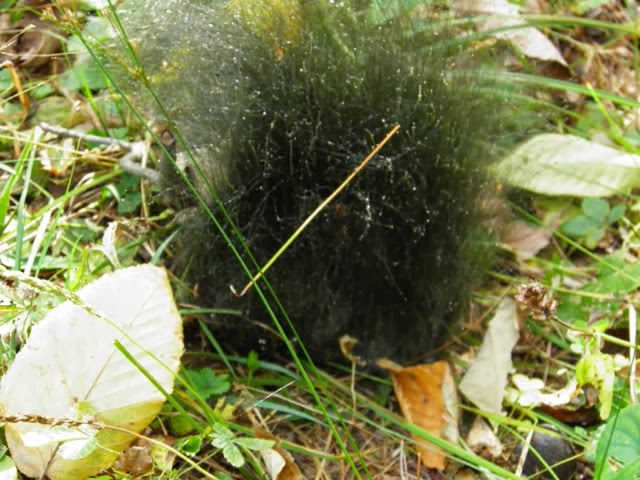
My friend and colleague Peter Busher was out doing fieldwork near his study site at the Quabbin Reservoir in Massachusetts. He took pictures of this creepy fungus that looked like a giant hairball. It was growing on fresh bear dung. 


Phycomyces is a fungus related to bread mold. Like many of the fungi in the bread mold group (Zygomycetes) it has evolved to grow on substrates that are high in sugar (Peter had seen the steaming pile, full of berries, on the road just a couple of hours before). This fungus is one of the first to colonize the fresh feces of vertebrates. 

Not a lovely proposition but perhaps not as gross as it sounds. Something out there has to get the process of decomposition started. And when the hairy fungus has exhausted the nutrients available to it something else takes over. Sooner or later the pile of shit is consumed and the road is clear again. 


The landscape we observe, human and otherwise, is a time-sensitive space. Things happen in it on time scales that range from nanoseconds to eons. Our time is like a snapshot. There are great volumes of existence in time before and after us. 

What does this have to do with Phycomyces? This ancient fungus, which has been around as long as land mammals (hundreds of millions of years), lives its life cycle in a matter of hours. Other components of the landscape, like the pond where Peter studies beavers, are a longer-lasting feature, though the ponds too are part of a cycle. Hundreds or thousands of years later they are gone, a tiny sliver of time. The flutter of a leaf is part of the landscape too. Something that ephemeral seems too short lived to be of any significance. But is it less important than the Phycomyces? The leaf falls, the hairy fungus disappears. The pond is overgrown and dries up. But at its muddy bottom, perhaps hundreds of feet down, lies pollen that was released in a moment during a day in spring, millions of years before.